
Watch Demo
Watch Demo
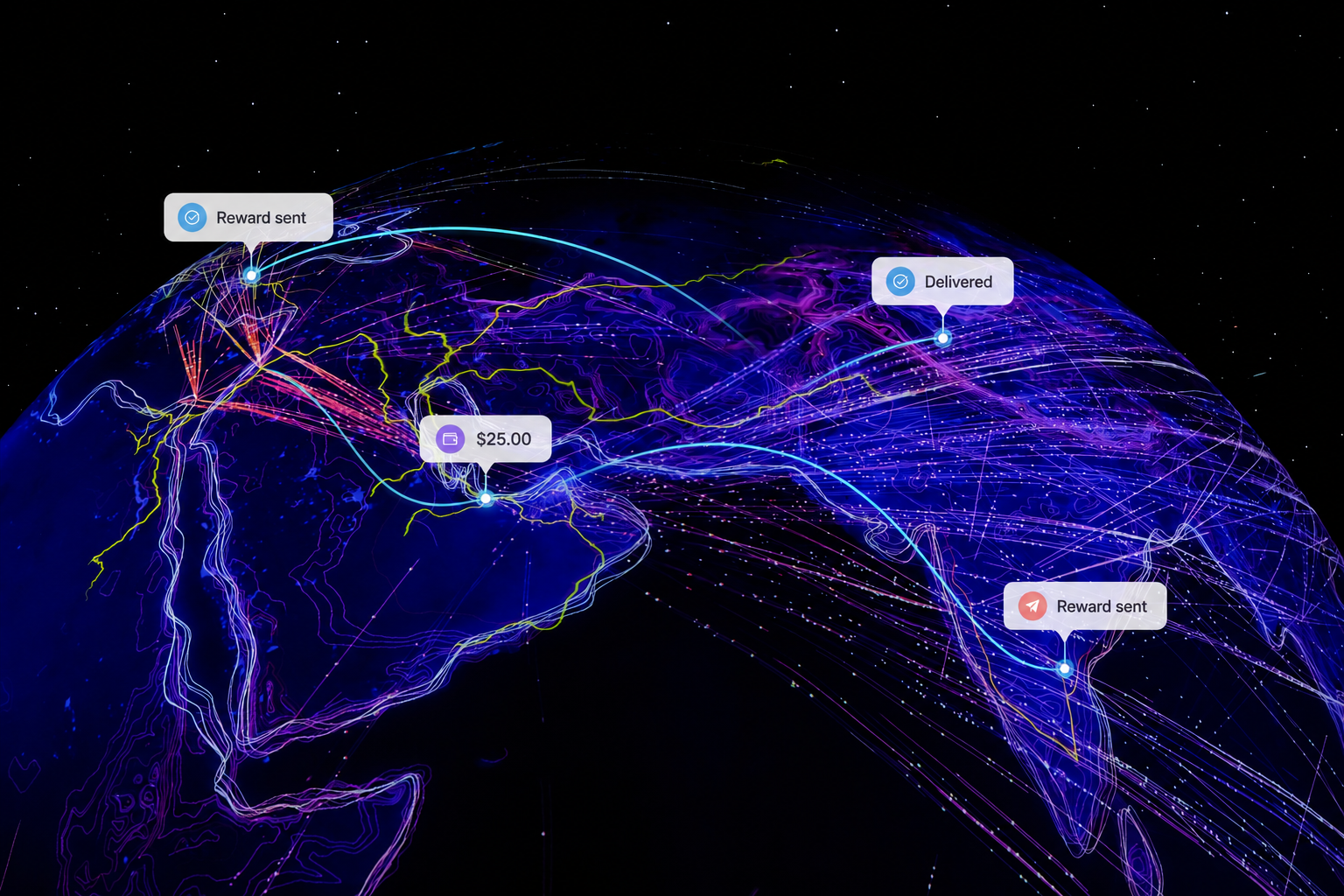
A rewards program that works well in one country rarely survives contact with a second one unchanged.
The logic seems simple enough. Pick a reward, pick an amount, send it everywhere. Then a participant in one market receives a card for a retailer that does not operate there, a recipient in another gets a value that feels insulting after conversion, and a finance team discovers a reporting obligation nobody planned for.
None of that is exotic. It is the normal result of treating international distribution as the same program with a different address.
This guide covers what actually changes when rewards cross borders, what to standardize, what to localize, and how to decide between them. For the underlying mechanics, see what digital payouts are.
Global rewards distribution is delivering incentives to recipients in multiple countries from one program.
The defining constraint is that you are running a single set of business rules across many local realities. Your eligibility logic, budget, and reporting stay central. Everything closer to the recipient — what they receive, in what currency, through which channel, under which rules — becomes local.
Most of the difficulty sits at that boundary.
Four things fail, roughly in this order. Teams usually plan for the last one and get caught by the first three.
Each of these is invisible in a domestic pilot and obvious the moment you add a second market.
Check availability per market before promising anything.
Equivalent effort should feel equivalently rewarded.
Confirm per market with local advice, not assumption.
The most common failure and the easiest to test in advance.
The catalogue is not global. A brand that dominates one market may have no presence in the next, and even where it exists the digital gift card product may not.
This is the fastest way to make a reward worthless. The recipient gets something they cannot spend, which is worse than getting nothing, because now they have also been disappointed.
Two practical habits fix most of it. Query availability per market rather than assuming a global list, and offer choice at redemption so the recipient selects from what is actually valid where they are. Reward choice solves internationally what it also solves domestically, covered in how gift card incentives work.
This is the distinction that separates programs that feel fair from programs that quietly offend people.
Converting an amount is arithmetic. A fixed sum becomes some other number in local currency, and the exchange rate moves it again next quarter.
Equivalence is a judgement. It asks whether the reward represents comparable value for comparable effort in that market. The same converted amount can be a meaningful thank you in one country and a rounding error in another.
You have to choose which one you are optimising for, and both choices are defensible.
For research incentives, calibration usually wins, because underpaying participants damages recruitment in that market for years. For employee recognition, consistency is often more defensible, because colleagues do compare. Decide deliberately rather than by default.
Reward preferences differ across markets in ways that are easy to get wrong from head office.
The safe approach is not to assume a stereotype but to remove the guess entirely. Offering a choice of reward types lets local preference express itself without you having to predict it, and it gives you data on what people in each market actually pick.
If you must standardize on one reward type, ask people in that market before deciding. A short question to a local team beats a confident assumption made three thousand miles away.
Incentive payments interact with local tax, employment, and financial rules, and those rules are genuinely different from country to country.
Some markets restrict cash-equivalent incentives. Some require local reporting above thresholds that differ from your home market. Employee rewards may be treated as compensation in ways that affect payroll. Data protection rules govern how you may store recipient details in the first place.
This article cannot tell you what applies to you, and neither can a vendor page. What it can tell you is the operational habit that makes compliance survivable: track cumulative value per recipient per market from the first send, and get local advice before launching in a market rather than after.
Delivery is the most common failure and the least glamorous to fix.
Email filtering behaves differently across providers and regions. Instructions written for one market may be unclear elsewhere. A claim process that assumes a particular device or payment habit will lose recipients who do not share it. Support offered only in one timezone leaves people waiting a day for help with money they were promised.
Test the whole path in each market before launch, not just the send. The reward arriving is the product.
The workable pattern is central rules, local delivery. This is roughly where the line falls.
Keep the rules identical everywhere. Let everything the recipient touches adapt to where they are.
There are three common shapes, and the right one depends on how many markets you run and how much local variation you can tolerate.
Start with coverage in the markets you actually operate in rather than the total country count on a marketing page. A provider supporting many countries thinly is worse than one supporting your five markets well.
It is not, and the recipient discovers this before you do. Query per market.
Conversion is arithmetic. Equivalence is a decision. Make it explicitly.
Compliance is far cheaper to design in than to retrofit, and retrofitting sometimes means contacting people you already paid.
Email behaviour, language, and claim flows all vary. Test the full path per market.
Someone chasing a missing reward at their midday should not wait until yours.
If you cannot compare redemption rates across markets, you cannot tell which one is broken.
Delivering incentives to recipients across multiple countries from a single program, with central rules and locally appropriate rewards and delivery.
It depends on the program. Participant and research incentives usually need local calibration to stay fair. Internal recognition often benefits from consistency because colleagues compare. Choose deliberately.
Brands have different market presence, and their digital gift card products are not available in every country even where the brand operates.
Track cumulative value per recipient per market from the first send and take local advice before launching in a market. Rules vary and change.
One provider is simpler to run and report on. Regional providers give better local coverage. Judge on coverage in the markets you actually serve, not on total country counts.
Delivery. Email filtering, unclear instructions, and claim flows that assume local habits cause more lost rewards than currency or compliance issues.
International reward programs do not fail because the idea is wrong. They fail because a domestic design gets copied across a border and nobody checks what changed.
The pattern that holds up is consistent everywhere it should be and flexible everywhere it must be. Keep eligibility, budget, and reporting central. Let the reward, the currency, the language, and the compliance handling adapt to where the recipient actually is.
And where you are unsure what someone in another market would value, give them the choice instead of guessing.
If you are extending a rewards program into new markets and want to talk through coverage and delivery, talk to the ORBT team.

What a reward API does, how the integration works, why idempotency matters, webhooks vs polling, funding, testing, and when you do not need one at all.
Read More ➞
How gift card incentives work: open vs closed loop, choosing denominations, delivery, breakage, fraud, and when a gift card is the wrong reward to send.
Read More ➞
Digital payouts explained: how they work, the payout methods available, what small payouts really cost, and how to choose the right method for each recipient.
Read More ➞Built on global gift-card infrastructure, ORBT connects your business to thousands of brands, enabling seamless digital value distribution at scale.
Contact Sales