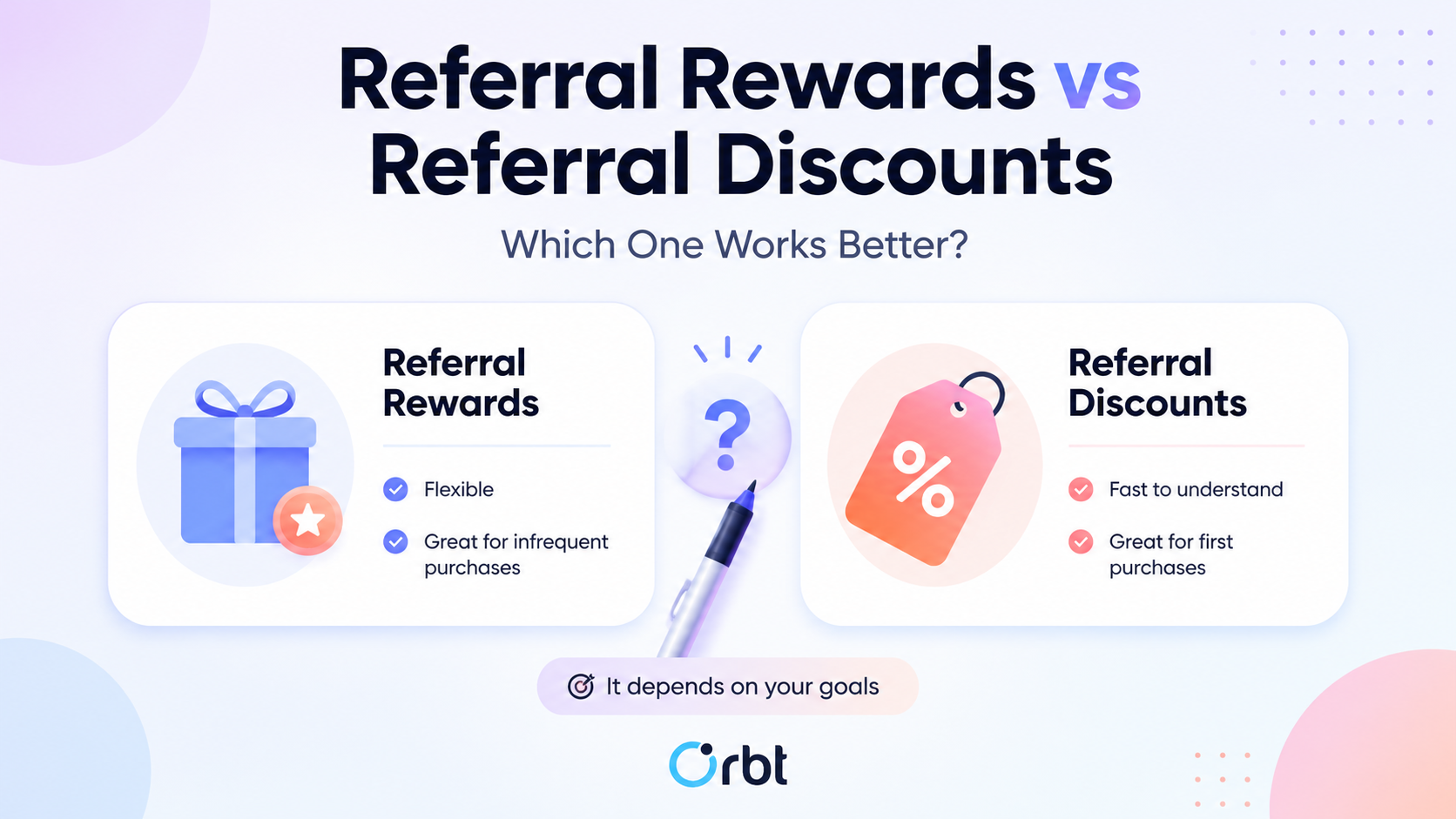
Referral Rewards vs Referral Discounts: Which One Works Better?

Published:
July 27, 2026

A referral program needs more than happy customers. It needs an incentive that makes people want to share, and it needs an offer that makes the referred person want to act.

For many businesses, the default referral incentive is a discount. Give a customer 10% off. Give their friend 10% off. Keep it simple.

That can work. Discounts are familiar, easy to understand, and directly tied to a purchase. But they are not always the best referral incentive. In some cases, a digital reward, gift card, account credit, store credit, loyalty reward, VIP perk, or cash-equivalent incentive can be more motivating than another percentage-off offer.

The difference matters because referral incentives shape customer behavior. A discount can reduce friction for someone who is already close to buying. A reward can motivate someone even when they are not planning another purchase right away. A VIP perk can make loyal customers feel like insiders, not just coupon users.

This guide breaks down the difference between referral rewards and referral discounts, when each one works best, and how to choose the right incentive for your double-sided referral program.

What Is a Referral Reward?

A referral reward is an incentive given to someone for participating in a referral program. Most often, it goes to an existing customer after they refer a new customer who completes a qualifying action.

That qualifying action might be a first purchase, signup, subscription, booked appointment, approved application, completed survey, or another verified conversion.

Referral rewards can include:

     
  • Digital gift cards
  •  
  • Store credit
  •  
  • Account credit
  •  
  • Cash-equivalent rewards
  •  
  • Loyalty points
  •  
  • Free products
  •  
  • Free months
  •  
  • Service credits
  •  
  • Exclusive perks
  •  
  • Charitable donations
  •  
  • Sweepstakes entries

The main advantage of a referral reward is flexibility. A business can give customers something valuable without always reducing the price of the product or service.

For example, a SaaS company might give the referrer a $25 digital gift card after their friend becomes a paying customer. The new customer might receive onboarding credit or a free first month. An ecommerce brand might give the referrer store credit, while the referred customer receives a welcome offer.

The goal is not just to give something away. The goal is to make the referral feel worth sharing and worth acting on. For more tactical examples, see our guide to referral reward ideas that drive signups.

What Is a Referral Discount?

A referral discount is a price reduction offered as part of a referral program. It usually gives either the referrer, the referred customer, or both sides a lower price.

Common referral discounts include:

     
  • 10% off your next order
  •  
  • $20 off your first purchase
  •  
  • Give 15%, get 15%
  •  
  • One free month after a friend subscribes
  •  
  • A discounted first appointment
  •  
  • A reduced setup fee
  •  
  • A first-order coupon code

Referral discounts are popular because they are simple. Customers understand them immediately. The business can tie them directly to a purchase, checkout flow, promo code, or referral link.

That simplicity is useful, especially for ecommerce, subscriptions, memberships, local services, and consumer brands. But discounts also have tradeoffs. They reduce revenue on the transaction, can train customers to wait for offers, and may not motivate people who are not planning to buy again soon.

Referral Rewards vs Referral Discounts: The Core Difference

The main difference is simple: a referral discount lowers the price of something the customer buys. A referral reward gives the customer something of value for completing the referral.

That distinction changes how the incentive feels.

A discount works best when the referred person is already considering a purchase. It helps reduce hesitation and makes the first order, booking, or subscription feel easier.

A reward works best when the referrer needs a reason to participate outside of their own next purchase. It can feel more tangible, more flexible, and more like a thank-you.

For example, compare these two offers:

     
  • Refer a friend and get 15% off your next purchase.
  •  
  • Refer a friend and get a $25 digital gift card.

The discount only matters if the customer wants to buy again. The gift card can be valuable even if they do not have an immediate need for another purchase.

That is why referral discounts often work well for frequent-purchase businesses, while referral rewards can work better when purchases are infrequent, high-consideration, or not naturally repeatable.

Referral Incentive Types

Referral Rewards vs Referral Discounts

Discounts reduce the price of a purchase. Rewards give customers something valuable for completing a referral. The best choice depends on what behavior you want to motivate.

Price reduction

Referral Discounts

Best when the referred customer is close to buying and needs a simple reason to act now.

  • Easy to understand
  • Works well at checkout
  • Good for frequent purchases
  • Can reduce margins if overused
Example Give 15%, get 15%
Access or status

VIP Perks

Best when loyal customers care about exclusivity, community, early access, or special treatment.

  • Builds emotional loyalty
  • Good for premium brands
  • Encourages advocacy
  • Less useful for price-sensitive audiences
Example Unlock early access

Where VIP Perks Fit In

Referral incentives are not limited to rewards and discounts. Some businesses also use VIP perks.

A VIP perk gives customers access, status, or exclusivity instead of a direct monetary incentive. Examples include:

     
  • Early access to new products
  •  
  • Priority support
  •  
  • Exclusive content
  •  
  • Private community access
  •  
  • Premium upgrades
  •  
  • Invitation-only events
  •  
  • Member-only experiences

VIP perks work best when customers care about identity, community, or status. They are common in lifestyle brands, premium products, creator communities, memberships, and brands with a strong fan base.

They are usually not the best fit when customers are mostly price-sensitive. But for loyal customers, VIP perks can turn referral participation into something that feels more personal than a coupon.

When Referral Discounts Work Best

Referral discounts work best when the discount removes friction from a purchase that is already likely to happen.

They are especially useful when the referred customer is close to buying but needs a small push to get started. The discount gives them a reason to act now instead of waiting, comparing, or abandoning the decision.

Frequent Purchase Businesses

Discounts are often a good fit for ecommerce brands, consumer subscriptions, food and beverage, beauty products, apparel, pet products, wellness products, and other categories where customers are likely to buy repeatedly.

If customers already plan to purchase again, a discount can be valuable because it applies directly to behavior they were going to take anyway.

For example, “Give $15, get $15” works well when both people can use the offer on a future order. The referrer gets a reason to return, and the referred customer gets a lower-friction first purchase.

First-Purchase Conversion

Referral discounts are strong when the main goal is getting a new customer to complete their first order.

A referred customer may trust the recommendation but still hesitate because of price, shipping, timing, or uncertainty. A discount reduces that friction.

This is especially true when the product is easy to understand and does not require a long sales process. If the person can quickly decide, add to cart, and buy, a referral discount can help turn the referral into revenue.

Short Sales Cycles

Discounts are useful when the offer needs to be extremely simple.

A customer can understand “20% off” instantly. They do not need to compare reward types, wait for a separate payout, or understand a complex points system.

That makes discounts useful in short attention environments like checkout pages, post-purchase emails, SMS, mobile app prompts, and social sharing.

When Referral Rewards Work Best

Referral rewards work best when the incentive needs to create motivation beyond a simple price reduction.

They are especially useful when the referrer may not be ready to buy again, when purchases are infrequent, when the business wants to avoid over-discounting, or when the referral action is not a direct ecommerce transaction.

Infrequent Purchase Businesses

If customers do not buy often, a discount on a future purchase may not be very motivating.

For example, a customer may love a home service, healthcare provider, software tool, insurance product, financial service, or professional service. But if they do not expect to buy again soon, “10% off your next purchase” does not feel very useful.

A referral reward solves that problem. A digital gift card, account credit, cash-equivalent reward, or thank-you incentive can motivate the referrer even when there is no immediate repeat purchase.

High-Consideration Purchases

Referral rewards are often better for products or services that require more trust, more research, or a longer decision cycle.

In these cases, the referral is valuable because it creates a warm introduction. The referrer may be putting their reputation behind the recommendation. A more tangible reward can feel appropriate because the referral has more value.

This can apply to B2B services, SaaS, financial services, healthcare, education, consulting, agencies, memberships, and marketplaces.

Research and Survey Incentives

Referral rewards are usually a better fit for research, surveys, panels, user interviews, and participant recruitment.

In these cases, the referred person is not buying a product. They are completing a survey, joining a panel, participating in research, or attending an interview. A discount does not make sense because there may be nothing to buy.

Digital rewards, eGift cards, and instant incentives are much more natural. They give participants a clear reason to complete the action and can help motivate quality participation when structured carefully.

Avoiding Discount Fatigue

Discounts can work, but overusing them can weaken brand perception.

If customers constantly see discounts, they may start to view the listed price as inflated or optional. They may delay purchases until another offer appears. They may also become less responsive over time as discounts feel less special.

Referral rewards can help avoid this issue. Instead of reducing the product price, the business offers a separate incentive for a valuable action. That can preserve pricing integrity while still giving customers a reason to participate.

Should You Use the Same Incentive for Both Sides?

Not always.

One common mistake is assuming the referrer and the referred customer should receive the same thing. Sometimes that works. “Give $20, get $20” is simple and memorable.

But the referrer and the referred customer often have different motivations.

The referred customer is new. They may need a reason to try the business, reduce risk, or make their first purchase.

The referrer already knows the business. They may value a digital gift card, store credit, account credit, loyalty points, or VIP perk more than a first-purchase discount.

That means a mixed incentive structure can work well.

     
  • Referrer gets a digital gift card. Referred customer gets 15% off.
  •  
  • Referrer gets account credit. Referred customer gets a free trial.
  •  
  • Referrer gets loyalty points. Referred customer gets a welcome credit.
  •  
  • Referrer gets a VIP perk. Referred customer gets a first-order discount.
  •  
  • Referrer gets a reward after verification. Referred participant gets an instant eGift after completing a study.

The best structure depends on what each side needs to take action.

Common Referral Incentive Structures

Give Discount, Get Discount

This is the classic ecommerce referral model. The referrer gets a discount on a future purchase, and the referred customer gets a discount on their first purchase.

It works best when both people are likely to buy from the business.

Example: Give 20% off, get 20% off.

Give Discount, Get Reward

This structure gives the referred customer a purchase discount while giving the referrer a separate reward.

It works well when the new customer needs a price incentive, but the existing customer may be more motivated by something flexible.

Example: Give your friend $20 off. Get a $25 digital gift card after their first purchase.

Give Credit, Get Credit

This structure keeps the reward inside the business. It is common for SaaS, marketplaces, subscriptions, ecommerce, and loyalty programs.

Example: Your friend gets $25 in account credit. You get $25 in account credit after they become a paying customer.

Give Trial, Get Reward

This structure is common for software, subscriptions, memberships, and services where the customer needs to experience the product before buying.

Example: Your friend gets a free month. You get a reward after they upgrade to a paid account.

Give Perk, Get Perk

This structure works well for brands with strong communities or premium positioning.

Example: Your friend gets early access to a new collection. You unlock VIP member status, priority support, or exclusive content.

Decision Tree

Which Referral Incentive Should You Use?

Start with the behavior you want to encourage. Discounts are best for purchase friction, rewards are best for flexible motivation, and VIP perks are best for loyalty and status.

Start here

What is the main goal of your referral program?

Need faster first purchases?

Use a referral discount

Best for ecommerce, retail, subscriptions, and short sales cycles.

Need to motivate referrers?

Use a referral reward

Best for infrequent purchases, B2B, research, surveys, and high-consideration offers.

Need to deepen loyalty?

Use a VIP perk

Best for premium brands, communities, memberships, and customer advocacy programs.

Simple rule: If the referred person needs a reason to buy, use a discount. If the referrer needs a reason to share, use a reward. If your best customers want recognition, use VIP perks.

How Discounts Affect Margins

Discounts are not free. They reduce revenue on the purchase where they are applied.

That does not mean discounts are bad. A discount can be profitable if it helps acquire a customer who would not have purchased otherwise. But businesses need to understand the margin impact.

For example, a 20% discount may seem modest. But if the product has tight margins, that discount can remove a large share of profit from the order.

The risk gets bigger when both sides receive discounts. If the referred customer gets a discount and the referrer gets a discount, the business is funding two incentives.

That can still make sense if the referred customer has strong lifetime value. But if the first purchase is low-margin and repeat purchase is uncertain, the program may look active while quietly losing money.

Margin Impact Calculator

How Much Does a Referral Discount Affect Profit?

Enter a simple order value, product margin, and referral discount to estimate how much gross profit is left after the discount.

Gross profit before discount $50.00
Discount cost $20.00
Profit after incentive $30.00
Healthy room left after the referral incentive.

This is a simple directional calculator, not a full financial model. For subscription, B2B, or repeat-purchase businesses, compare incentive cost against expected customer lifetime value.

How Rewards Affect Margins

Rewards also have a cost, but they can be easier to control.

A business can set a fixed reward amount, delay payout until a qualified action, cap rewards per customer, or choose reward types that match the value of the referral.

For example, a $25 digital gift card after a first paid subscription may be easier to model than a percentage discount that changes based on order size.

Store credit and account credit can also support retention because they encourage the customer to return. A digital gift card may feel more flexible and motivating, especially when the referrer may not buy again soon.

The key is choosing a reward that is valuable enough to motivate action but not so large that it attracts low-quality referrals or harms profitability.

How to Choose the Right Referral Incentive

The right incentive depends on the business model, purchase frequency, customer motivation, and economics of the referral.

A referral discount may be better when:

     
  • The referred customer is close to buying.
  •  
  • The business has frequent repeat purchases.
  •  
  • The offer is simple and transactional.
  •  
  • The audience is price-sensitive.
  •  
  • The discount can be tied directly to checkout.
  •  
  • The business has enough margin to support the price reduction.

A referral reward may be better when:

     
  • The referrer is not likely to buy again soon.
  •  
  • The purchase is infrequent or high-consideration.
  •  
  • The business wants to avoid over-discounting.
  •  
  • The referral action is not a purchase.
  •  
  • The audience values flexibility.
  •  
  • The business wants a more tangible thank-you.

A VIP perk may be better when:

     
  • The brand has a strong community.
  •  
  • Customers care about status or exclusivity.
  •  
  • The business sells premium, lifestyle, or membership-based products.
  •  
  • The goal is to deepen loyalty, not only drive transactions.
  •  
  • The audience is less motivated by small discounts.

Many businesses should use a mix. The referred customer might get a discount, while the referrer gets a reward. Loyal advocates might unlock VIP perks after multiple successful referrals.

Business Model Guide

Best Referral Incentive by Business Model

Different businesses need different incentives. Use the customer’s buying behavior, purchase frequency, and motivation to choose the right offer.

Ecommerce

Best fit: Discount + store credit

A first-order discount helps the referred customer buy, while store credit brings the referrer back for another purchase.

SaaS

Best fit: Account credit or free month

Credits and free months keep the reward tied to product usage, retention, and subscription value.

Research & Surveys

Best fit: Digital reward

Participants are completing an action, not buying something, so eGift cards and instant incentives are more natural than discounts.

B2B Services

Best fit: Gift card, service credit, or donation

Professional referrals often need a flexible thank-you reward tied to a qualified meeting, contract, or first invoice.

Healthcare & Wellness

Best fit: Approved wellness incentive

Rewards should be structured carefully around policy, privacy, eligibility, and applicable compliance requirements.

Memberships & Communities

Best fit: Points, perks, or exclusive access

Member-based businesses can use referrals to reinforce belonging, status, and ongoing participation.

Best Incentive Types by Business Model

For ecommerce, referral discounts and store credit often work well. A first-order discount helps convert the new customer, while store credit brings the referrer back.

For SaaS, account credit, free months, and usage credits are usually strong options. These rewards keep customers engaged with the product.

For financial services, digital gift cards, account bonuses, and statement credits may be more appropriate, depending on the rules and eligibility requirements.

For healthcare and wellness, incentives need to be structured carefully around policy, privacy, and compliance. Wellness rewards, approved gift cards, or welcome incentives may be more appropriate than aggressive cash-like offers.

For research and surveys, digital rewards are usually better than discounts because the participant is completing an action rather than buying something.

For B2B services, referral rewards, service credits, donations, or gift cards may be more effective than discounts, especially when the referrer is making a professional introduction.

For memberships and communities, points, account credits, free months, exclusive access, and VIP perks can work well because they reinforce continued participation.

Common Mistakes to Avoid

Defaulting to Discounts Without Considering Rewards

Discounts are easy, but they are not always the most motivating option.

If the referrer does not want to buy again soon, a discount may not move them. If the business wants to protect pricing, a discount may create more problems than it solves.

Before defaulting to a coupon, consider whether a reward or VIP perk would create stronger motivation.

Giving the Same Incentive to Both Sides Without Thinking

The referrer and the referred customer may need different things.

The referred customer may need a reason to try the business. The referrer may need a reason to share. Those are related, but not identical.

A mixed structure is often stronger than a matching structure.

Making the Reward Too Small to Matter

A referral asks someone to take action. They need to share a link, recommend a business, talk to a friend, or put their name behind the introduction.

If the reward feels meaningless, participation will be low.

The reward does not need to be excessive, but it should feel worth the effort.

Paying Too Much Too Early

The opposite mistake is paying too much before the business receives value.

This can attract low-quality referrals, self-referrals, duplicate accounts, or people who are only interested in the incentive.

For higher-value rewards, tie the payout to a meaningful action such as first purchase, first paid month, verified completion, approved application, completed appointment, or first invoice paid.

Ignoring the Referral Experience

Even a strong incentive can fail if the referral experience is confusing.

The customer should understand what they are sharing, what their friend gets, what they get, when rewards are issued, and what actions qualify.

The referred person should land on a page that clearly explains the offer and makes the next step easy.

FAQ

What is the difference between a referral reward and a referral discount?

A referral reward gives someone something of value for participating in the referral program, such as a digital gift card, account credit, store credit, loyalty points, or free month. A referral discount reduces the price of a purchase, such as 10% off or $20 off.

Are referral rewards better than discounts?

Referral rewards can be better when purchases are infrequent, the referrer is not ready to buy again, or the business wants to avoid over-discounting. Discounts can be better when the referred customer is close to buying and needs a simple price incentive.

Where do VIP perks fit into referral programs?

VIP perks work well when customers care about exclusivity, access, or status. They can include early access, priority support, private community access, premium upgrades, or invitation-only experiences.

Do referral discounts hurt margins?

They can. A discount reduces revenue on the purchase where it is applied. Whether that is a problem depends on the business’s margins, average order value, repeat purchase rate, and customer lifetime value.

Should both sides get the same referral incentive?

Not always. In many cases, the referred customer should receive a discount or welcome offer, while the referrer receives a reward after the referred customer completes a qualified action.

What is a good referral reward?

A good referral reward is relevant, easy to understand, and tied to the value of the referral. Digital gift cards, store credit, account credit, loyalty points, service credits, and VIP perks are common options.

Final Thoughts: Match the Incentive to the Behavior You Want

Referral rewards, referral discounts, and VIP perks can all work. The right choice depends on what you want people to do.

Use discounts when you want to reduce purchase friction. Use rewards when you want to motivate sharing, thank customers, support non-purchase actions, or avoid over-discounting. Use VIP perks when you want to make loyal customers feel like insiders.

For many businesses, the best structure is not reward versus discount. It is reward plus discount.

Give the referred customer a reason to act. Give the referrer a reason to share. Then tie the payout to a conversion event that protects the business.

If your business is building a referral, loyalty, research, employee, or customer incentive program, ORBT can help you deliver flexible digital rewards at scale. To learn more, visit ORBT’s contact page.

Ready to Transform
Your Digital Value?

Built on global gift-card infrastructure, ORBT connects your business to thousands of brands, enabling seamless digital value distribution at scale.

Contact Sales